
Data centers are expanding rapidly, while grid capacity and water availability are becoming increasingly constrained in many regions. The IEA notes: “[…] IEA analysis of data centers dedicated to AI reveals that nearly 40% of identified capacity is in areas with high or extremely high baseline water stress.” 1
INNIO’s generator technology helps data centers address these challenges by combining reliable onsite power with closed-loop engine cooling and dry-cooled heat rejection to minimize freshwater consumption*.
With this approach, data center developers can gain a clear advantage in site selection, permitting, and operational resilience.
Minimizing water use to near-zero levels with INNIO’s power generation technology
INNIO’s Jenbacher gas engine generators use closed-loop engine cooling: coolant circulates continuously through the engine and heat exchangers and is reused within the system. When paired with dry cooling, where heat is transferred to ambient air rather than through an evaporative tower, there is no continuous evaporative cooling in normal operation. Freshwater demand is limited to the initial fill, condition-based service, and auxiliary volumes.
In a model-based configuration, water consumption can be below 0.1 liters/MWh2 – compared with up to 700 liters/MWh3 for reference thermal power plants, depending on configuration and operating conditions.
<0.1 liters/MWh
water consumption possible with Jenbacher closed-loop engine cooling + dry cooling 2
Improving efficiency beyond power generation
The water-performance objective and the energy-efficiency objective should be considered together. Adding heat recovery (CHP) or trigeneration (CCHP) increases total fuel utilization: recovered heat can be used directly or converted into chilled water via absorption chillers, reducing cooling energy demand. This combination supports improvement in both PUE (power usage effectiveness) and WUE (water usage effectiveness) at facility level, helping operators demonstrate measurable sustainability performance of their power plants.
Modular and integrated power generation solution: Jenbacher Type 6
INNIO’s containerized Jenbacher Type 6 solutions combine high power density, rapid installation and flexible operation in a compact, plug-and-play format. Jenbacher Type 6 engine technology can provide a long-term power solution rather than serving only as a temporary bridge during grid interconnection delays. More broadly, Jenbacher engines are suited for prime, bridge-to-grid, and backup applications. For developers, this modularity supports phased capacity expansion in line with campus growth while helping maintain operational continuity under dynamic load conditions. At the same time, INNIO’s “Ready for H2” pathway creates a natural bridge toward further decarbonization. Built as natural gas assets today, Jenbacher units can support hydrogen admixing and, depending on configuration and application, may be converted for operation with up to 100% (vol) hydrogen in the future.
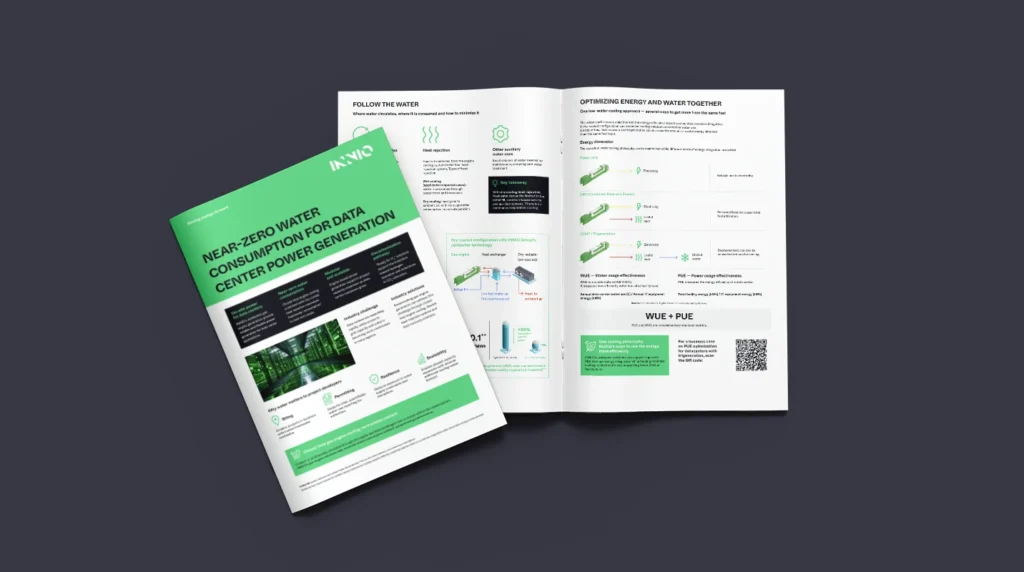
Discover how INNIO can enable near-zero water consumption for data center power generation and download the factsheet.
Footnote:
*Initial fill: coolant held and recirculated inside the equipment. This is a one-time inventory, not continuous consumption. Small volumes may be required for condition-based maintenance or auxiliary systems. With dry-cooled heat rejection, there is no continuous evaporative water consumption during normal operation.
In general, “Ready for H2” Jenbacher units can be converted to operate on up to 100% hydrogen in the future. Details on cost and timeline may vary and need to be clarified individually.
Sources:
1 Source: International Energy Agency (IEA), Powering Artificial Intelligence, published October 14, 2026.
2 Based on INNIO internal sources (model-based assumption), at 8,000 oph/year with water service intervals every 20,000 oph.
3 BloombergNEF, Thirst for Power: Water Stress in Electricity Generation, September 8, 2026, Table 3, Appendix A.
Other sources indicate some specific cases with water consumption at around 200 liters/MWh.


